Folded.
Carefully.
Deliberately.
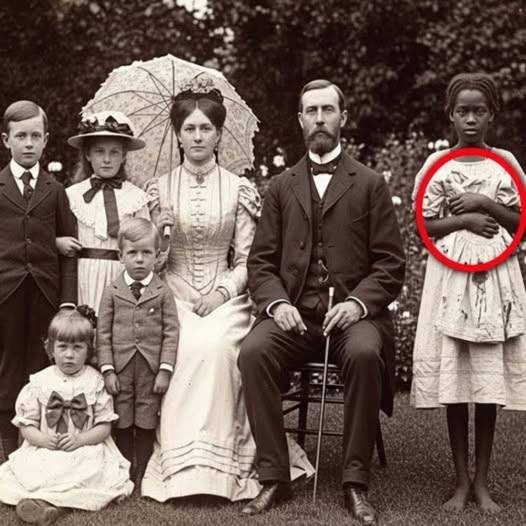
Then he saw the stains.
Even through the limitations of 19th-century photography, the markings were unmistakable:
Irregular distribution
Dense central saturation
Radiating splatter pattern
These characteristics align with what forensic specialists classify as:
biological fluid dispersion consistent with blood exposure during trauma events
Ricardo immediately contacted a specialist.
Mariana Guzmán, a historian focused on Porfirian social systems, labor structures, and photographic documentation, arrived within hours.
She studied the image in silence.
Then she confirmed what the evidence suggested:
“Those are bloodstains.”
From that moment, the photograph shifted categories.
It was no longer a portrait.
It was evidence.
Over the next weeks, their investigation expanded into multiple disciplines:
Historical labor records analysis
Property registry research
Archival forensic document examination
Textile and material science evaluation
They identified the location:
Hacienda San Miguel de las Flores, Jalisco
A working estate during a period when Mexico had officially abolished slavery—but continued operating under debt peonage systems, widely recognized by scholars as economic coercion equivalent to forced labor.
In archived worker records, they found a critical entry:
A five-year-old child.
Recorded death.
Severe burns.
No medical treatment.
No formal burial.
Three days later:
A family portrait was commissioned.
The timeline aligned exactly with the photograph.
They identified the girl at the edge of the frame:
Josefina.
Eight years old.
Assigned to domestic labor.
Sister of the deceased child.
The dress she held?
Belonged to her sister.
A third expert, specializing in historical textiles and fabric damage analysis, confirmed additional details:
The material was low-grade cotton used in labor garments
The tear pattern indicated thermal damage
The staining pattern confirmed direct trauma exposure
This was not symbolic.