Hidden in Plain Sight: Forensic Image Analysis Reveals a 19th-Century Hacienda Secret, Child Labor Death Records, and the Untold Evidence Buried in a Family Portrait

The photographs arrived in a sealed wooden box—an artifact in itself—bearing the worn insignia of a long-defunct photographic studio.
Inside were 17 glass plate images.
All followed a familiar pattern:
Wealthy landowning families
Carefully staged outdoor compositions
Visible displays of status, clothing, and property
These were not just family portraits.
They were visual declarations of economic power, land control, and social hierarchy—common among hacienda elites in 19th-century Mexico.
Ricardo began routine cataloging.
Then he reached the thirteenth image.
At first glance, it appeared ordinary.
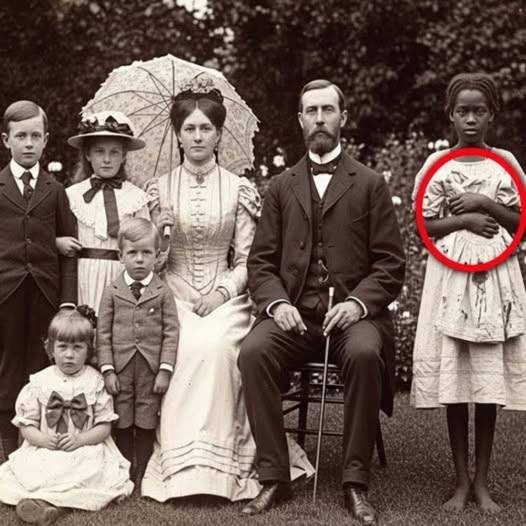
A well-dressed family posed in a manicured garden:
A patriarch seated with a cane
A woman under a parasol
Children arranged symmetrically
Floral landscaping signaling wealth and control over land
This composition aligned perfectly with documented visual patterns in elite agricultural estates during the 1800s.
But something disrupted that symmetry.
At the far right edge stood a child.
She was not dressed like the others.
Her clothing suggested domestic labor status—coarse fabric, minimal tailoring, no decorative elements.
She stood slightly outside the focal plane.
Almost erased.
But not completely.
Ricardo noticed something critical:
She was holding an object.
Not casually.
Not loosely.
But tightly, pressed against her chest with deliberate force.
That night, the image stayed with him.
This is a common phenomenon in investigative archival work—when a visual inconsistency triggers deeper analysis. Experts in forensic photography and historical reconstruction refer to this as a “visual anomaly signal.”
The next morning, Ricardo initiated a full scan using high-resolution archival digitization technology.
This process is essential in modern historical research because it allows:
Pixel-level examination
Texture analysis of materials
Identification of patterns invisible to the naked eye
The scan took hours.
When it finished, he zoomed in.
The object was not a simple cloth bundle.
It was a child’s dress.