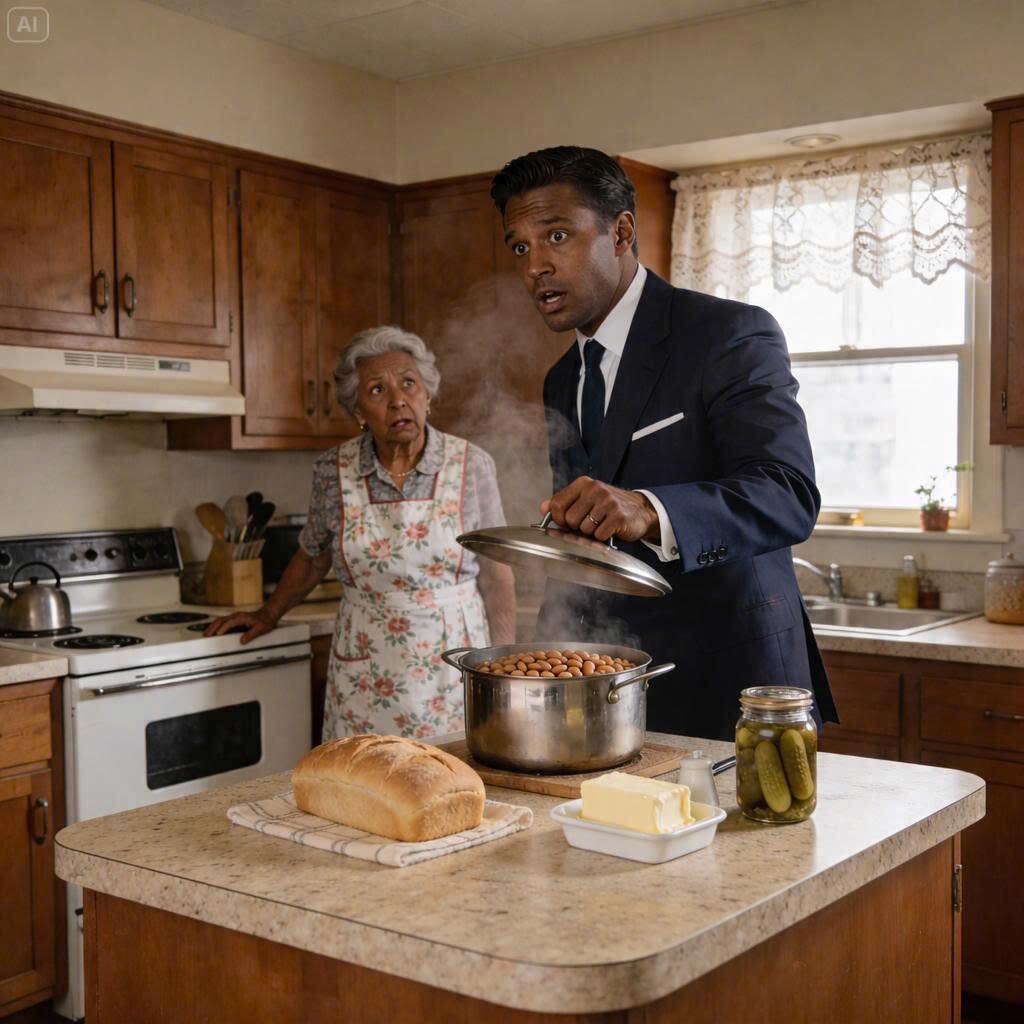
There are mothers who would use that moment to scold, to list every cold month, every lonely Christmas Eve, every call that ended too fast. Maybe they would be right. But looking at him now, you understand something unbearable: he wasn’t absent because he stopped loving you. He was absent because he trusted the wrong woman to stand in the narrow bridge between his intention and your reality.
And trust, once misplaced, can starve people just as surely as neglect.
“I’m sorry,” he says. “I’m so sorry.”
You put your hand on his hair the way you did when fever took him as a boy and he shook through the night on a mattress you could barely afford. “I know,” you whisper, even though knowing is not the same as forgiving and forgiveness is not yet in the room. “I know, mijo.”
He presses his forehead to your lap and cries.
Not loud. Not elegantly. Just with the helpless shame of a man who has finally understood that money sent is not love delivered. You sit there in your faded blue dress with one hand on his head and the other near the bank book and let the moment be ugly. Christmas has no use for polished lies anymore.
Later, when the first storm inside him calms, he stands and begins to pace the kitchen.
“How long?” he asks.
You answer honestly. “A year of nothing. Before that, smaller things. Medicines you said you’d cover that never arrived. Winter blankets she told me were delayed. She once said you wanted to pay for a woman to come help me twice a week, but I told her no because I was proud.” You look at him. “I never told her no.”
His jaw tightens visibly.